The answer first
A small business should adopt AI automation by starting with one bounded, reversible workflow and a named owner—not with an autonomous agent or a company-wide transformation. Define the current baseline, permitted data, acceptable error boundary, and human approval points first. Then run a limited pilot, inspect useful and failed outcomes, document the operating process, and expand only when the controls and monitoring work in practice.
This sequence keeps the decision focused on an operating problem rather than a tool catalog. The U.S. Small Business Administration advises small businesses to start small, test whether AI adds value, and consider benefits and risks together in its AI for small businesses guidance. That guidance does not promise a return or prescribe a fixed calendar. Your phase gates should depend on evidence from the workflow, and a responsible outcome may be to redesign or stop.
The roadmap below applies to deterministic automation, assistive AI, and selected model-supported decisions. If a later use case truly needs contextual tool selection or retries, the agentic workflows explainer covers that separate design territory. The destination is not autonomy; it is a workflow that remains understandable, owned, and useful.
Key Takeaways
- Choose the first candidate for low consequence, reversibility, observable results, available data, and a willing process owner—not for novelty.
- Write a baseline and acceptance boundary before testing so the pilot can produce a continue, modify, or stop decision instead of a polished demonstration.
- Keep human review at irreversible or high-consequence steps during early adoption, and give reviewers a clear escalation and manual fallback path.
- Treat governance, data, performance, and monitoring as ongoing operating responsibilities, not paperwork completed once before launch.
Frame the roadmap as evidence gates, not deadlines
A calendar can coordinate work, but it should not decide whether a workflow advances. A simple pilot may move through the gates quickly; a process with sensitive records, multiple integrations, or consequential outputs may need more review. Use artifacts and observed behavior as the gate: a signed use-case charter, a current-process map, a representative test set, an exception log, a standard operating procedure, and a live review record.
This article adapts the voluntary NIST AI Risk Management Framework into a compact business sequence. NIST describes four functions—Govern, Map, Measure, and Manage—and notes that identifying and managing AI risks and impacts requires perspectives across the AI lifecycle. Its AI Risk Management Framework page supports those functions, but NIST does not mandate the phases or small-business artifacts presented here.
Proportionate participation does not require a large committee. The workflow owner should seek input from people who provide the data, perform the work, receive the output, administer connected systems, and handle relevant privacy or security questions. One person may hold several roles in a small firm, but each perspective still needs an explicit answer.
Use five phases with explicit dispositions
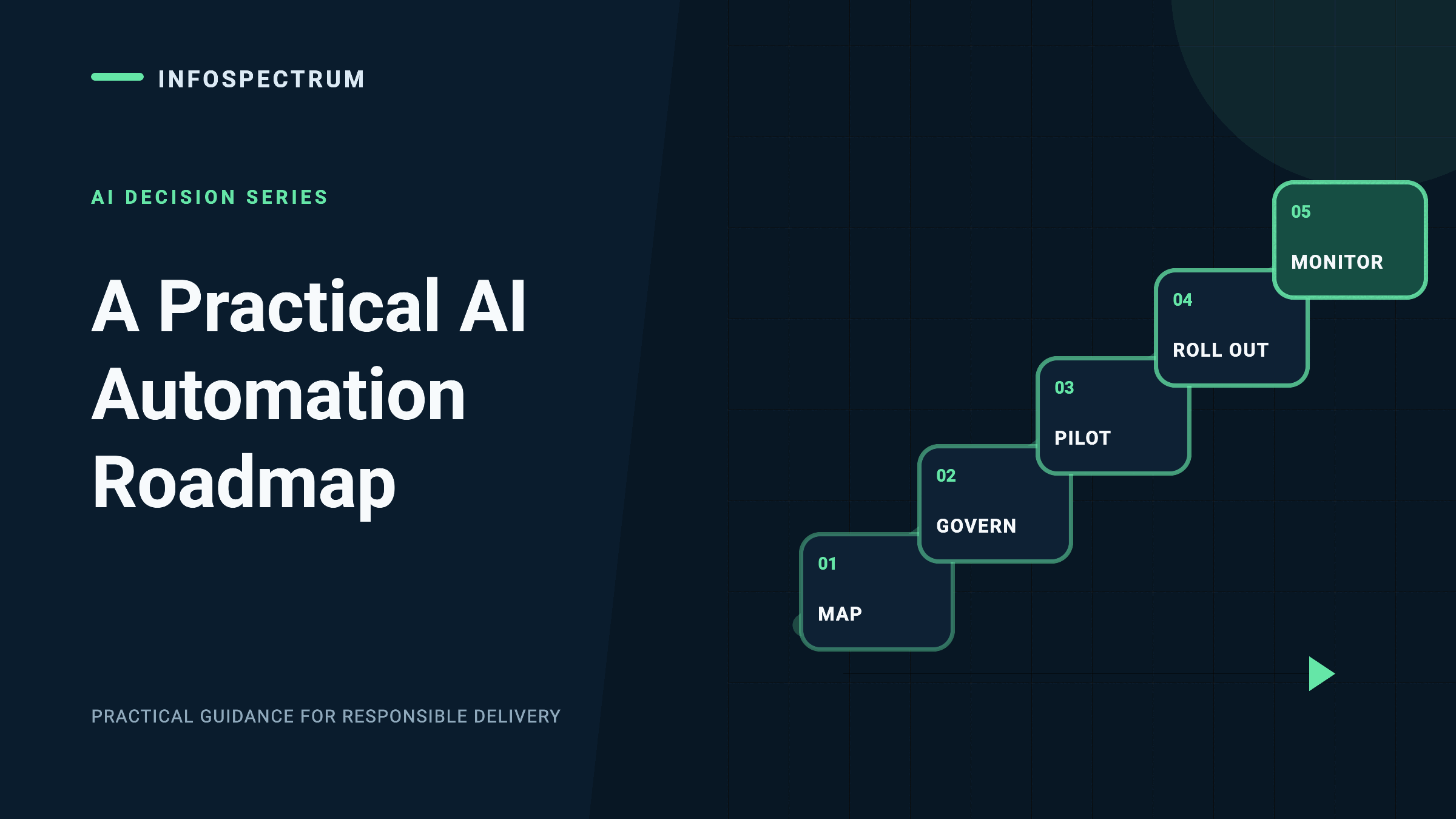
The table turns adoption into five reviewable decisions. Each phase produces a minimum artifact and an explicit disposition. It deliberately starts before product selection and continues after rollout. The sequence is an editorial adaptation for smaller organizations, not a government-prescribed implementation method.
| Phase | Decision gate | Minimum evidence or artifact | Responsible disposition |
|---|---|---|---|
| 0. Govern and inventory | Is there a named owner, permitted data class, affected-user view, and acceptable consequence boundary? | One-page use-case charter, data map, prohibited actions, approval roles, and escalation path | Reject or redesign when ownership, authority, or the data boundary is unclear |
| 1. Map and select | Is the workflow bounded, repeated, reversible, observable, and suitable for a limited test? | Current-process map, baseline measures, candidate scorecard, and manual fallback | Select one assistive or low-consequence step; defer broader action |
| 2. Pilot and measure | Does the test add operational value within the stated boundary, and which failures appear? | Representative test set, acceptance criteria, reviewer log, exception categories, and control checks | Continue, modify, or stop based on recorded evidence rather than novelty |
| 3. Controlled rollout | Can a defined group operate the workflow with permissions, approvals, logs, training, and recovery? | Standard operating procedure, role access, approval points, rollback path, and staff guidance | Expand only to the documented users, inputs, actions, and volume boundary |
| 4. Manage and improve | Does the live workflow remain useful and within its approved operating boundary after changes? | Operational measures, incident and exception review, owner review, change log, and retirement criteria | Maintain, reconfigure, pause, narrow, expand carefully, or retire |
Phase 0: govern the use case before shopping
Write a one-page charter that names the business purpose, process owner, users, affected people, permitted inputs, prohibited inputs, intended output, connected systems, and actions the automation may never take. Add the person who can pause the pilot and the manual route used when the system or reviewer is unavailable. If the team cannot describe the boundary without naming a vendor, the use case is still too vague.
Separate data authority from technical availability. A record being accessible through an application does not answer whether it may be used for this purpose, sent to a model service, retained in logs, or shown to a reviewer. Map prompt inputs, retrieved context, generated outputs, feedback, logs, exports, and support access. When deployment location becomes a material question, review the boundaries of a privately hosted LLM service rather than assuming this adoption roadmap chooses an architecture.
Define consequences in operational language. A low-consequence drafting assistant may produce text that a person edits before use. An automation that sends a message, changes a customer record, schedules work, approves a transaction, or removes access can create harder-to-reverse effects. Keep human approval at irreversible or high-consequence steps during early adoption. This is a conservative recommendation; review does not eliminate risk or replace qualified legal, privacy, security, or industry-specific judgment.
Phase 1: map candidates and select one bounded step
Map the current process from trigger to completed outcome, including queues, handoffs, exceptions, rework, and the systems people consult. Ask where the process repeats, where judgment is truly required, where data is missing, and where an error becomes difficult to reverse. A useful first candidate has a clear beginning and end, examples for testing, outputs a reviewer can inspect, and an owner prepared to handle exceptions.
Record a baseline before changing the work. Choose measures already meaningful to the process: elapsed time, staff touch time, correction count, incomplete records, handoff delay, or exception volume. Do not invent a target from an industry claim. The baseline only needs to be consistent enough to compare the same defined workflow before and during the pilot. If data quality is unclear, improving collection or rules may be the next action instead of adding AI.
Score candidates against consequence, reversibility, observability, data readiness, integration complexity, exception burden, and owner capacity. Start with extraction, classification, search, or drafting that supports a person rather than an action that silently commits the business. InfoSpectrum’s workflow automation service can help map handoffs and rules, while database development capabilities may be relevant when reliable records and audit history are prerequisites.
- Prefer a single step over an end-to-end process when ownership or exception behavior is still uncertain.
- Require representative examples, including ambiguous, incomplete, and out-of-scope inputs.
- Identify the manual fallback before testing the automated path.
- Document why rejected candidates were deferred so they do not reappear without changed evidence.
Phase 2: run a reviewed pilot that can fail usefully
Build a test set from permitted, representative records and include normal cases, edge cases, missing fields, conflicting instructions, and examples that should be rejected or escalated. Define acceptance criteria before seeing results. Criteria may cover completeness, correct classification, appropriate abstention, reviewer correction, required citations, or whether a downstream action remained blocked. Avoid one blended score that hides a dangerous failure category.
Run the pilot with a named reviewer and a bounded user group. Record the input category, output disposition, correction, exception, escalation, and whether the manual route worked. Reviewers need a concise rubric; asking whether an output “looks good” produces weak evidence. Preserve enough context to diagnose patterns without retaining data beyond the approved need.
Evaluate operational value and failure modes together. A workflow can produce convenient drafts yet create new review queues, inconsistent records, or hard-to-detect omissions. Conversely, a pilot that does not advance can still reveal a missing data field, an unclear policy, or an unowned exception. The gate is not “Did the model impress us?” It is “Can this bounded process operate within the charter, and what evidence supports the next disposition?”
Phase 3: convert the pilot into a controlled operation
A successful test does not yet define a service. Before rollout, write a standard operating procedure that covers eligible work, prohibited inputs, user roles, approval points, exception handling, outages, manual fallback, escalation, and pause authority. Apply role-based access to source data and downstream actions. Log the events needed to reconstruct important decisions without treating indiscriminate retention as a control.
Train the defined user group on the workflow boundary, not just the interface. People should know what the automation does, what it does not decide, how to review output, where to report a problem, and when to use the manual route. If the workflow interacts with customers, ensure the handoff and review design matches the actual channel; a specialized chatbot development approach may be relevant, but it does not replace use-case governance.
Expand by a defined dimension—such as users, input category, action type, or volume—rather than changing several boundaries at once. Keep the previous manual process available until the owner has evidence that rollback works. New integrations, data classes, model versions, prompts, tools, or action permissions should trigger review proportionate to the change.
Phase 4: monitor, change, pause, and retire
The U.S. Government Accountability Office organizes its accountability framework around governance, data, performance, and monitoring, and describes continuous monitoring across AI system deployment. The GAO AI accountability framework was developed for federal agencies and other entities, not as a small-business playbook. This roadmap adapts those distinct concerns into an owner review rather than claiming that GAO prescribed this checklist.
Monitor the same operating measures used in the baseline plus exceptions, overrides, escalations, incidents, unreviewed outputs, and changes to data or integrations. Choose a review cadence based on consequence and change rate; available evidence does not establish a universal frequency. Look for drift in the business process as well as model behavior. A workflow can become inappropriate because a policy, product, staff role, or customer expectation changed.
Give the owner authority to maintain, narrow, reconfigure, pause, or retire the workflow. Expansion is only one possible outcome. Preserve a change log that records what changed, why, who approved it, what was tested, and which rollback path remains available. For broader implementation planning across systems and responsibilities, review InfoSpectrum’s services overview; keep the workflow decision record specific even when several disciplines are involved.
Keep the decision record small enough to use
The roadmap does not need a heavy governance platform. A versioned decision record can link the charter, process map, baseline, test set, acceptance boundary, exception log, operating procedure, access roles, change history, and latest owner review. Store each artifact where responsible staff can find it, and identify the source of truth rather than scattering approvals across chat messages.
At every gate, write one disposition: reject, redesign, pilot, roll out within a defined boundary, expand carefully, pause, or retire. Add the evidence, unresolved conditions, owner, and next review trigger. This makes uncertainty visible without pretending every issue can be resolved before learning begins. It also prevents a promising demonstration from silently becoming an unowned production process.
A practical AI roadmap is not a race toward autonomy; it is a sequence of owned decisions that makes every expansion earn its evidence.
InfoSpectrum Engineering
Frequently Asked Questions
What is the best first AI automation project for a small business?
Choose a bounded, repeated, low-consequence step with representative examples, observable outputs, a manual fallback, and a named owner. Assistive extraction, classification, search, or drafting is often easier to review than an automation that takes an irreversible action.
Does an AI automation roadmap need a fixed timeline?
No. A calendar can coordinate work, but advancement should depend on evidence: a clear charter, usable baseline, representative test, understood exceptions, working controls, and an owned monitoring process. Complex or consequential workflows may need more review.
When should human review remain in an AI workflow?
Keep human approval at irreversible or high-consequence steps during early adoption, and retain it wherever the approved risk boundary requires judgment. Reviewers need a rubric, escalation route, and manual fallback; human review does not guarantee a correct or lawful outcome.
How should a small business decide whether to expand an AI pilot?
Compare the pilot with the defined baseline and acceptance boundary, inspect failure categories and operational side effects, confirm that permissions, logs, training, fallback, and ownership work, then record a continue, modify, narrow, pause, or stop decision.
Sources
- Manage your businessU.S. Small Business Administration (SBA)
Supports recommending that small businesses start small, test whether AI adds value, and consider benefits and risks together. It does not support a fixed implementation calendar, quantified return, or guaranteed outcome.
- AI Risk Management FrameworkNational Institute of Standards and Technology (NIST), AI Resource Center
Supports organizing AI risk work around Govern, Map, Measure, and Manage and involving perspectives across the AI lifecycle. The article's phases and compact artifacts are an editorial small-business adaptation, not a NIST-mandated chronology.
- Artificial Intelligence: An Accountability Framework for Federal Agencies and Other EntitiesU.S. Government Accountability Office (GAO)
Supports treating governance, data, performance, and monitoring as complementary accountability concerns and continuing monitoring after deployment. The lightweight owner review is an editorial adaptation, not GAO guidance written specifically for small businesses.
Bring one workflow, its current process, and its open decision gates to InfoSpectrum Engineering to scope a bounded automation pilot with explicit ownership, review, and fallback.


