The answer first
Choose a private AI deployment by matching documented controls to a defined data class and workflow, not by assuming that one server location is always safer. The practical choice is the least operationally burdensome option that can demonstrate the required data boundary, processing geography, retention and review behavior, identity controls, logging, deletion process, and contractual commitments.
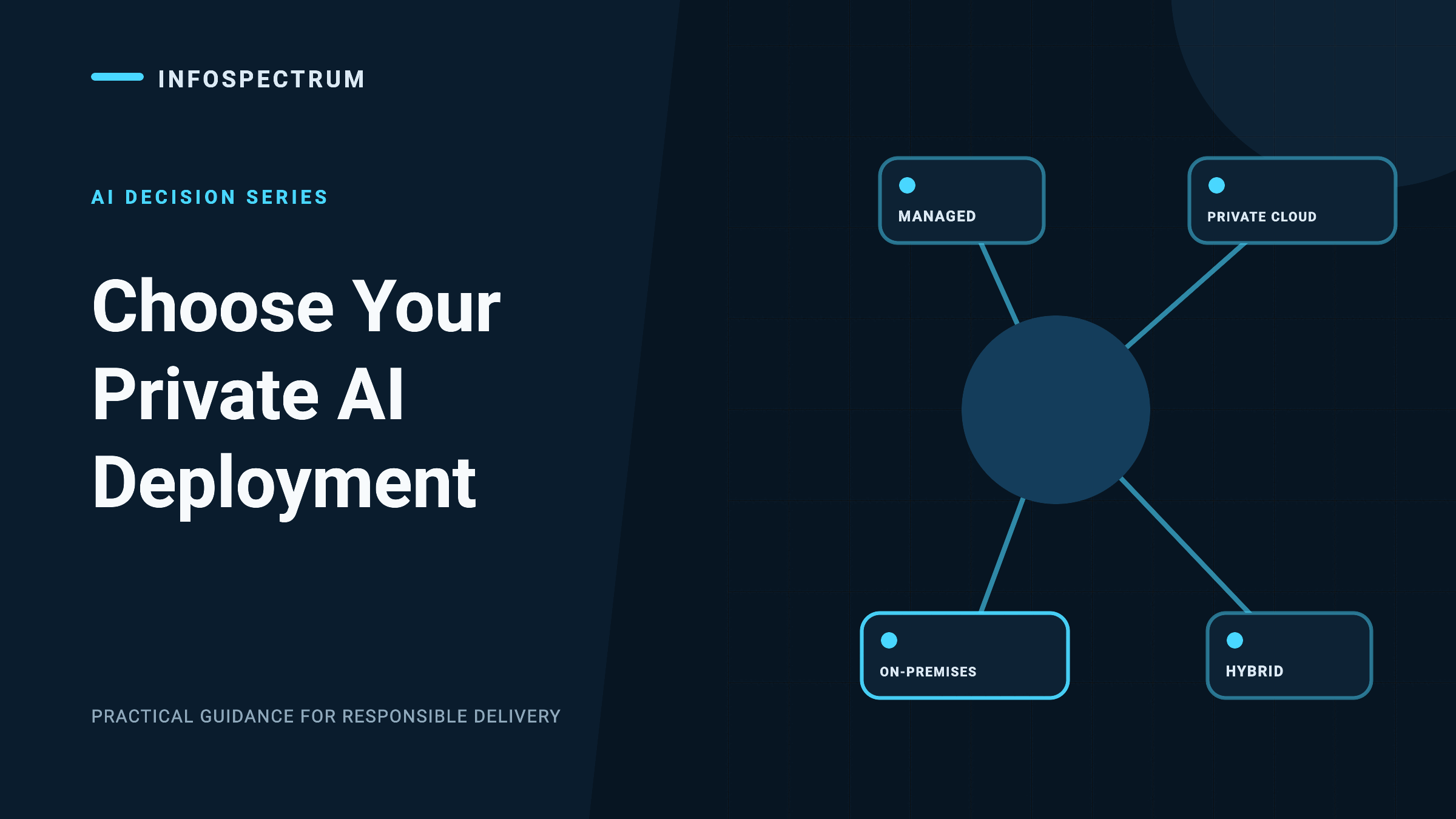
That choice may be a managed business AI product, a managed model service connected to a private cloud environment, a self-managed system on organization-operated infrastructure, or a hybrid route that sends different data classes to different approved environments. Each can be reasonable under the right conditions. None becomes private, secure, or compliant merely because a product name includes “enterprise,” a network uses a private endpoint, or servers sit inside a building.
Use the matrix below before selecting a vendor or architecture. Teams that need a deeper implementation discussion can also review InfoSpectrum’s privately hosted LLM service, while the LAN-hosted model perspective covers local implementation territory rather than the procurement decision addressed here.
Key Takeaways
- Start with the intended data flow, users, integrations, outputs, and review path; “cloud” and “on-premises” are too broad to serve as approval criteria.
- Require evidence for training use, retention, review, geography, identity, logging, deletion, networking, and operating ownership at the exact product, plan, feature, and region under consideration.
- Treat private connectivity and physical location as boundaries to verify, not substitutes for authentication, authorization, monitoring, patching, or incident handling.
- Route a use case to an approved environment only after owners record the evidence, unresolved conditions, review date, and conditions that require reapproval.
Begin with the workflow and data boundary
Write the workflow as a data-flow narrative before discussing deployment. Name what users enter, what connected systems retrieve, where prompts and retrieved records travel, what the model returns, where outputs are stored, who can see them, and what happens when the workflow fails. Include administrative access and support paths. A short diagram or sequence list is more useful here than a generic label such as “internal assistant.”
Classify the actual inputs rather than the project as a whole. One assistant may answer public product questions, summarize internal procedures, and process restricted records. Those are three routing decisions. If data classes differ, either constrain the workflow to one approved class or design explicit routes with visible rules. Do not rely on users to remember an unwritten boundary every time they paste text.
For each route, assign owners for business approval, data handling, identity, system operation, and exception review. A team can use a broader services overview to frame implementation responsibilities, but the approval record should remain specific: service name, plan or SKU, deployment type, region, enabled features, connected storage, and contract version.
- Inventory prompt data, retrieved context, generated outputs, logs, feedback, evaluation records, and support access.
- Record every system boundary crossed, including fallback routes and feature-specific storage.
- Name who approves access, operates controls, reviews exceptions, and rechecks provider documentation.
- Separate verified facts from assumptions and conditions that remain open.
Compare four deployment patterns with one matrix
The following matrix is a decision aid, not a ranking. Read across a row to identify why an option might fit, which evidence must exist before approval, and which shortcut the team must avoid. A candidate that cannot answer a required question is not automatically rejected, but the unanswered condition should remain visible rather than being converted into a favorable assumption.
| Deployment pattern | Consider when | Verify before approval | Ownership question | Do not assume |
|---|---|---|---|---|
| Managed business AI or API | The provider’s documented behavior and contract fit the approved data class and workflow | Training use, retention, review, geography, tenant boundary, deletion, identity, logs, and subprocessors | Which controls belong to the provider, customer administrator, application team, and user? | All managed products, plans, or features follow one policy |
| Managed model service in a private cloud environment | The team needs managed model operations with private networking, cloud identity, logging, or geography choices | Exact service, SKU, region, deployment type, endpoint path, storage, monitoring, persistence, and shared duties | Who configures network paths, permissions, logs, keys, storage, and connected applications? | A private endpoint makes the complete solution private, secure, or compliant |
| Self-managed or on-premises | Organization-operated infrastructure or offline operation is a required boundary, or third-party processing is unacceptable | Authentication, authorization, segmentation, encryption, updates, model provenance, telemetry, logs, backups, and incident process | Who maintains the model-serving stack and every surrounding control over time? | Physical or LAN location establishes trust or satisfies a rule |
| Hybrid or routed use | Different data classes have distinct approved environments and routing can be made explicit | Classification, routing, redaction, fallback, observability, user override, failure handling, and route testing | Who owns routing rules and investigates misclassification or an unavailable destination? | Architecture alone prevents accidental disclosure |
Evaluate managed AI at product and feature level
A managed AI decision should begin with the exact offering, not a vendor-level reputation. Request current documentation and contract language for the product, plan, deployment type, geography, and features the workflow will use. Ask whether prompts, outputs, files, feedback, evaluations, filters, or support artifacts are stored; why they are stored; who can access them; how deletion works; and whether any material may be used for training or service review.
Microsoft’s scoped documentation for Models sold by Azure in Microsoft Foundry states that prompts and responses are not available to OpenAI or other model providers and are not used to train foundation models without customer permission or instruction. It also says prompts and responses are processed within the customer-specified geography, while explicitly identifying different behavior for Global and DataZone deployment types and possible processing between regions within a geography. Those statements are a vendor-specific example, not a rule for other services or every Foundry feature.
Convert documentation into an approval record with links, retrieval dates, configuration conditions, and named reviewers. Recheck it before publication or procurement because provider behavior can change. Where legal, privacy, security, or compliance review is warranted, route the exact evidence and proposed configuration to the organization’s responsible owners; do not replace their decision with an architecture label.
Inspect the whole private-cloud path
A managed model service connected through private cloud networking can narrow one part of the path, but the complete application includes identity, gateways, retrieval systems, object stores, logs, user interfaces, monitoring, and downstream actions. Draw the full route from user to model and back. Confirm whether any public endpoint, external integration, support channel, or fallback bypasses the intended boundary.
AWS states on its Amazon Bedrock Security and Privacy page that tuning uses a private copy so customer data is not shared with model providers or used to improve base models. The same page describes PrivateLink connectivity from a VPC without exposing that VPC to internet traffic and CloudTrail monitoring of API activity. These are relevant procurement controls for that service; they are not an independent evaluation of the application and do not establish a compliance outcome.
Assign configuration ownership explicitly. The cloud provider may document a capability while the customer remains responsible for enabling it, limiting permissions, choosing regions, retaining useful logs, protecting connected stores, and reviewing alerts. Teams that need help defining those boundaries can examine hosting service responsibilities as a starting point, then produce a configuration-specific responsibility map for the AI workflow.
Treat on-premises as an operating model
Self-managed deployment can be the appropriate choice when data must remain on organization-operated infrastructure, offline operation is required, or third-party processing is unacceptable. That placement changes the boundary and the operator. It does not remove the need to authenticate users and devices, authorize each resource, separate administrative access, review telemetry, maintain software, protect logs and backups, and respond to incidents.
The NIST Zero Trust Architecture publication states that implicit trust should not be granted solely because of physical or network location or asset ownership, and that subject and device authentication and authorization occur before a session to an enterprise resource. Applied narrowly here, a LAN boundary is not an access decision. This does not mean on-premises systems are inherently untrustworthy; it means their controls must be explicit.
Before approval, name the people responsible for account lifecycle, authorization rules, model and dependency updates, provenance review, telemetry decisions, backup restoration, log review, vulnerability response, and service recovery. If those duties are unowned, the architecture is incomplete even when the model server is already available. Do not fill the gap with unsupported estimates about hardware, deployment time, throughput, quality, or total cost.
Make hybrid routing visible and testable
A hybrid pattern can separate public or low-sensitivity work from data that requires a more restricted environment. Define the routes in policy and code: accepted data classes, approved destination, prohibited content, redaction behavior, user notice, fallback behavior, and escalation path. If the restricted destination is unavailable, failing closed, queuing work, or requiring manual handling may be preferable to silently sending data elsewhere; choose and document the behavior for the use case.
Test routing with representative inputs, ambiguous inputs, missing labels, pasted attachments, integration failures, and attempts to override the rule. Record which route was selected and why. Make exceptions visible to an owner. The workflow automation service provides context for explicit handoffs and exception paths, but every AI route still needs its own approved data rules.
Hybrid design does not prove that accidental disclosure is impossible. It creates more than one approved destination and therefore requires understandable routing, observability, and failure handling. Keep a manual route for uncertain cases, and review routing decisions when data classes, integrations, provider terms, or business purposes change.
Use an evidence-based approval sequence
Run the selection as a sequence of reviewable decisions. First, approve the use case and data classes. Second, map the complete data flow and operating roles. Third, compare candidate controls against the same matrix. Fourth, collect product-, plan-, configuration-, and region-specific evidence. Fifth, record gaps and obtain decisions from the responsible business, data, security, privacy, legal, or compliance owners where applicable. Finally, approve a bounded configuration with a review date and change triggers.
The resulting decision record should name the chosen pattern, exact services, enabled features, approved data, prohibited data, identity model, storage and deletion behavior, logging plan, operating owners, unresolved conditions, source links, retrieval dates, and reapproval triggers. Provider documentation changes, a new feature, a different region, an added integration, or a new data class can all justify reopening the decision.
Do not add invented precision where evidence is absent. This comparison does not establish relative cost, performance, return on investment, model quality, hardware sizing, deployment speed, or regulatory status. Those questions require separate, current evidence for the candidate configuration. The decision guide instead keeps the first procurement question disciplined: which option can document the required controls, and who will operate them?
- Approve the workflow and data classes before evaluating products.
- Collect exact, dated evidence and preserve every configuration caveat.
- Assign each control and unresolved condition to a named role.
- Set review dates and change triggers instead of treating approval as permanent.
Private AI is not a place on a network map; it is a documented agreement about data boundaries, control ownership, and the conditions under which a workflow may run.
InfoSpectrum Engineering
Frequently Asked Questions
Is on-premises AI always the most private option?
No. On-premises placement changes who operates the infrastructure and where processing occurs, but it does not by itself establish trust, access control, logging, deletion, or a compliance outcome. Compare the complete workflow and documented controls.
Can a managed cloud AI service handle sensitive business data?
Potentially, when the exact product, plan, configuration, region, contract, and operating controls satisfy the approved data class and workflow. Do not generalize one provider’s documentation to another service or assume every feature behaves alike.
Does a private endpoint make an AI application private?
No. A private endpoint can constrain a network path, but the application also includes identities, storage, logs, integrations, administrative access, fallbacks, and downstream actions. Verify the complete path and each owner’s responsibilities.
When should a business use a hybrid AI deployment?
Consider hybrid routing when distinct data classes have distinct approved environments and the organization can make classification, routing, redaction, fallback, observability, exceptions, and failure handling explicit and testable.
Sources
- Zero Trust ArchitectureNational Institute of Standards and Technology (NIST), Computer Security Resource Center
Supports the narrow claims that physical or network location alone does not establish implicit trust and that explicit subject and device authentication and authorization remain necessary. It does not compare model quality, price, or compliance.
- Data, privacy, and security for Models sold by Azure in Microsoft FoundryMicrosoft Learn / Microsoft
Supports the vendor-specific statements about provider access, training restrictions, and processing-geography conditions for the scoped Microsoft service, including Global and DataZone limitations. It does not establish behavior for other services or every Foundry feature.
- Amazon Bedrock Security and PrivacyAmazon Web Services (AWS)
Supports the vendor-specific statements about tuned-model data, PrivateLink connectivity, and CloudTrail API activity monitoring for Amazon Bedrock. It does not establish that Bedrock, a VPC, or PrivateLink makes a complete application compliant or risk-free.
Bring your workflow, data classes, and open control questions to InfoSpectrum Engineering for a deployment decision workshop grounded in evidence and operating ownership.


